The Cell Stores the Energy. The BMS Makes It Usable.
Interesting development last month: Schaeffler and CATL announced they’re deepening their collaboration on Battery Management Systems. Look closely at how they’ve split the work.
CATL, the world’s largest cell manufacturer, brings its expertise in cells and battery systems, battery algorithms, and industrialisation at scale. Schaeffler brings hardware and software development, system integration, functional safety, testing and validation, and European series production.
That’s worth pondering. CATL kept the algorithms in-house; the part that actually decides how a battery is used. It brought in a specialist for the hardware, integration, and safety validation instead.
The company that understands the cell best doesn’t need to own every part of the BMS. But the part it’s guarding most closely is the intelligence layer, not the hardware.
I think that points to a broader shift in how we should think about batteries. We tend to view the battery industry through the lens o
f the cell, because that’s where the energy is stored, and naturally, that’s where attention goes.
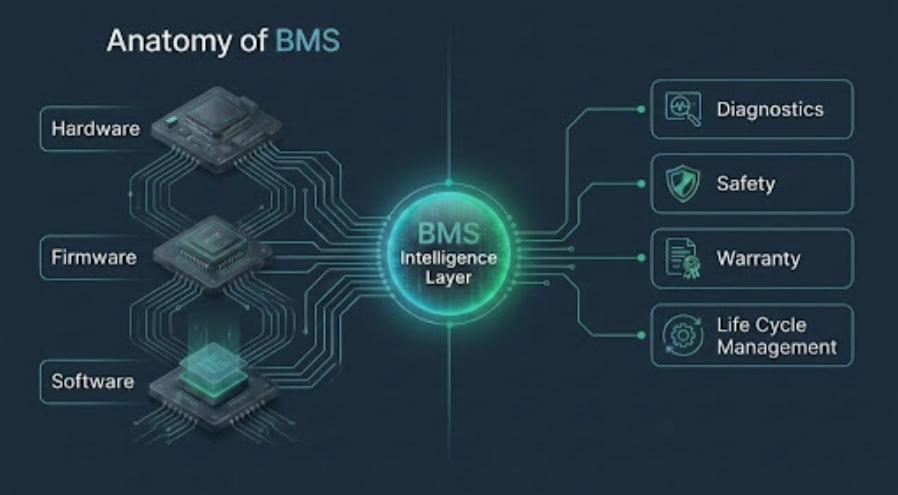
But the value of a battery was never just about how much energy it can store. It’s about how much of that energy can actually be used, how safely, how reliably, and for how long. That’s where the BMS becomes interesting.
The same cell can go into an EV, a solar storage system, or a telecom backup unit. But the duty cycle is different. The operating conditions are different. The safety requirements are different. The way the battery ages is different.
The cell doesn’t know any of this. The BMS is what makes that distinction possible.
As battery applications get more demanding, and as new chemistries like sodium-ion enter the market alongside established ones like LFP, this becomes even more important. Better state-of-charge and state-of-health estimation. Better thermal management. Better balancing. Better protection. Better understanding of how a battery is actually being used in the field.
Not just to make the battery safer. To extract more usable life out of the same hardware.
There’s a second layer to this that I find genuinely interesting. A BMS doesn’t stop mattering once the battery is sold. The data it generates over years of operation can inform diagnostics, warranty decisions, and eventually, second-life applications. That’s a very different kind of ongoing relevance than a component that ships once and is done.
I don’t think this means cells become less important. They won’t. Chemistry and materials science are still where a lot of the hard physics gets solved, and that work will keep driving real gains in energy density and cost.
But I do think the differentiated value in a battery is increasingly shifting toward the intelligence that surrounds the cell, not just the cell itself. And if even the world’s largest cell maker guards its algorithms this closely while opening up the hardware and integration side, that tells you something about where the real value is seen to sit.
The cell stores the energy. The BMS makes the energy usable.
Curious what others closer to cell manufacturing are seeing here!
– Dr. Raghu Raman Sekhar
Link to news – Schaeffler press release